

Hirsch Whiskey: The Legendary Bourbon Name Collectors Still Chase
There is a name in American whiskey that collectors say with a particular reverence — different from the awe attached to Pappy Van Winkle or George T. Stagg, different from the allocation anxiety around Eagle Rare or Blanton's. The name is A.H. Hirsch, and the whiskey attached to it is not merely rare or expensive. It is irreplaceable. It is, in the most literal sense, gone — the distillery that made it no longer exists, the equipment was demolished, and the last of the 1974 barrels were bottled over thirty years ago. What remains in the world is what remains, and nothing will ever be added.
Wooden Cork carries one of the most comprehensive A.H. Hirsch collections available from any single specialty retailer. This is the complete story of why these bottles exist, what they are, and why they command prices between $3,000 and $17,000 a bottle from collectors who understand exactly what they are buying.
Adolph Hirsch and the 1974 Commission
The story begins with a business decision. In 1974, Adolph Hirsch — a former executive at Schenley Distillers, one of American whiskey's major mid-century production companies — commissioned a batch of bourbon at a small distillery in Schaefferstown, Pennsylvania. The distillery was then operating under the name Pennco, though it would soon be purchased in foreclosure and renamed Michter's. Its history stretched back to the mid-1700s, predating American independence. The site is listed as a National Historic Landmark.
What made Pennco distinctive, and what made Hirsch's commission unusual, was the distillation equipment: small copper pot stills, a technology that was already functionally extinct in American commercial bourbon production by 1974. The rest of the industry had long since converted to column stills — the efficient continuous-distillation technology that produces the clean, high-proof spirit that modern bourbon and Tennessee whiskey are built on. Pot stills are a batch process, distilling in round copper vessels that retain more of the grain's congeners — the flavor compounds that column distillation strips away in pursuit of efficiency and consistency. Pot still bourbon is richer, more complex at the distillate level, and fundamentally different in character from anything a column still produces.
Hirsch laid down 400 barrels of this pot still bourbon in 1974. Then largely left them alone.
What Happened Next: Foreclosure, Orphaned Barrels, and a Rescue
The Schaefferstown distillery's financial history was turbulent. Purchased in foreclosure and renamed Michter's, it operated through the 1970s and 1980s as the bourbon industry endured one of its worst commercial periods — the era when American whiskey lost market share to vodka, wine, and imported spirits and numerous distilleries closed permanently. Michter's was among them: the facility ceased production in 1989 and never reopened.
By 1989, Hirsch's 400 barrels had been aging for 15 years. With the distillery closing around them, something had to be done. Hirsch acquired the barrels and arranged for their transfer to Kentucky for final evaluation and bottling. Most of the stock was moved to stainless steel tanks, which halted the aging process at 15 to 16 years. A portion of the barrels remained in wood for continued aging, eventually yielding the 18-year, 19-year, and 20-year bottlings that represent the oldest and rarest expressions of the Hirsch program.
The man Hirsch worked with to bring the whiskey to market was Julian Van Winkle III — grandson of the legendary Pappy Van Winkle, founder of the Old Rip Van Winkle Distillery, and one of the most respected palates in American bourbon. Julian personally oversaw the selection and bottling of A.H. Hirsch Reserve. His involvement in a non-Van Winkle project speaks to the extraordinary regard the whiskey community had for the 1974 Schaefferstown stock. The bourbon received America's first-ever five-star spirits rating.
Preiss Imports handled distribution. The bottles went to market under the A.H. Hirsch Reserve label.
Why This Bourbon Cannot Be Replicated
The question collectors ask — and the answer that drives the prices — is why these specific bottles cannot be reproduced under any circumstances.
The Michter's Schaefferstown distillery ceased production in 1989. The facility has never reopened. The current Michter's brand — Fort Nelson Distillery in Louisville, Kentucky — acquired the Michter's name but has no physical, operational, or ownership connection to the original Pennsylvania facility. When Michter's Louisville releases a premium expression, it is distilling at a modern Louisville facility from its own production program. It has nothing to do with Schaefferstown. The 1974 A.H. Hirsch Reserve is genuinely Pennsylvania pot still bourbon from a defunct distillery; current Michter's is a Louisville brand that happens to share a name.
The 1974 grain crop cannot be replicated. The specific copper pot still equipment used at Schaefferstown was demolished with the distillery. Pennsylvania's regional climate, water, and the specific aging conditions of those barrels in 1974 cannot be recreated. And most conclusively: the 1974 barrels are exhausted. Every bottle that will ever exist from this production run has already been filled. The universe of A.H. Hirsch Reserve is closed.
What this means in practice is that every bottle that leaves the secondary market is one fewer bottle that will ever exist in the world. There is no new production coming. There is no second run. When a collector acquires a bottle of A.H. Hirsch Reserve, they are acquiring a finite piece of American whiskey history that is diminishing with every transaction.
The Expressions: A Complete Guide
15 Year Old — Gold Wax, Perfect Wax (700ml, Distilled 1974, Bottled 1990)
The 15 Year was the first primary expression — distilled 1974, bottled in 1990 as Michter's closed, in a 700ml European export format. The Gold Wax Perfect Wax designation is the collector's highest condition grade: the wax seal entirely intact after over 35 years, no cracking, no deterioration. The 700ml format identifies this as the Continental distribution bottling, slightly smaller than the domestic 750ml. Julian Van Winkle III's involvement in the bottling program and the direct connection to the Schaefferstown closure makes the 1990 bottling one of the most provenance-documented expressions in the entire Hirsch catalog. One bottle in the current Wooden Cork collection at $11,999.
16 Year Old — Gold Foil Standard Bottling
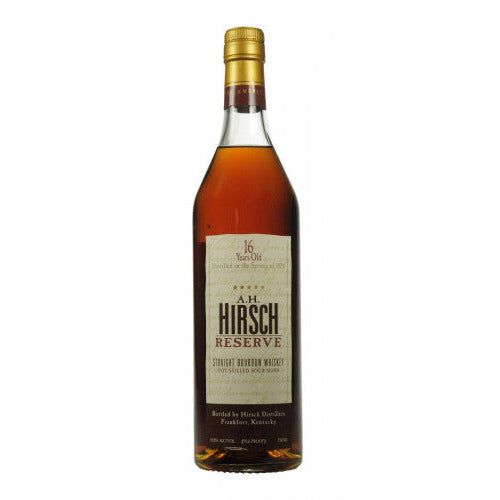
The 16 Year Gold Foil is the primary domestic presentation of the celebrated 16-year expression — the age statement that received America's first five-star spirits rating. The Gold Foil capsule is the premium presentation variant distinguishing it from the wax-sealed versions. Same 1974 Schaefferstown pot still distillate, aged 16 years, in the standard 750ml domestic format. Available at $4,299.99 — the most accessible entry point into the Hirsch 16 Year in the current Wooden Cork catalog.
16 Year Old — Gold Foil Humidor Edition
The humidor edition presents the same 16 Year Gold Foil liquid in a limited edition humidor box — one of the most distinctive presentation formats in American bourbon's modern history. Production was limited to approximately 4,244 cases total across all 16-year variants from 400 barrels. With decades of attrition since original release, surviving humidor editions represent a small fraction of even that limited original production. Available at $8,999.99.
16 Year Old — Gold Wax (Spring 1974, Perfect Wax, 750ml)
The Gold Wax Spring 1974 designation is the most precisely documented A.H. Hirsch expression in the collection. Pennsylvania distilleries historically tracked production by season — spring distillation runs have different fermentation conditions from fall runs due to temperature variation. The Spring 1974 designation on the Gold Wax is the most granular provenance documentation available for any Hirsch expression. Combined with Perfect Wax condition (the highest physical condition grade) and 750ml domestic format, this is the rarest and most valuable standard Hirsch 16 Year in the collection at $16,669.99.
16 Year Old — Gold Wax (Final Julian Van Winkle III Bottling, 750ml)
This gold wax bottling was among the last A.H. Hirsch releases that Julian Van Winkle III personally supervised before the brand passed to Sazerac. The Van Winkle connection makes this a documented piece of bourbon history that extends beyond the Old Rip Van Winkle and Pappy labels — evidence of Julian's personal engagement with non-Van Winkle whiskey of extraordinary quality. Available at $6,899.99.
16 Year Old — Blue Wax
The Blue Wax seal identifies this as a specific Preiss Imports presentation variant of the 16 Year — one of the more distinctive and less common wax colors in the Hirsch lineup. Same 1974 Schaefferstown pot still bourbon at 90.4 proof. Available at $7,899.99.
16 Year Old — Black Wax (Mint Wax)
The Black Wax is the baseline Preiss Imports presentation for the 16 Year, with Mint Wax condition indicating the seal is in exceptional preserved state. The Black Wax is the most commonly encountered Hirsch 16 Year wax variant in the collector market, with the Mint Wax condition elevating this specific bottle above average. Available at $11,299.99.
20 Year Old — Red Wax Mint Condition (750ml)
The 20 Year Red Wax in mint condition is the rarest and most mature expression of the Hirsch bourbon program. Most of the 1974 barrels were transferred to stainless steel in 1989-1990, halting the aging at 15 to 16 years. Only the barrels left in wood produced the 18, 19, and 20-year bottlings. At 20 years this Pennsylvania pot still bourbon reached a depth of maturity that no other American rye or bourbon from a genuine pre-Prohibition-era copper pot still tradition has ever achieved commercially. America's first five-star spirits rating was earned at 16 years; the 20 Year represents four more years beyond that benchmark. Available at $9,999.99.
20 Year Old — Red Wax (Standard, 750ml)
The standard Red Wax 20 Year — the same five-years-beyond-the-celebrated-16-year expression at the deepest aging in the Hirsch Reserve program, without the mint condition premium of the separate listing. Eight bottles in the current Wooden Cork collection — the most available single Hirsch expression in the catalog. Available at $7,899.99.
Hirsch Selection 1983 22 Year Old Straight Rye
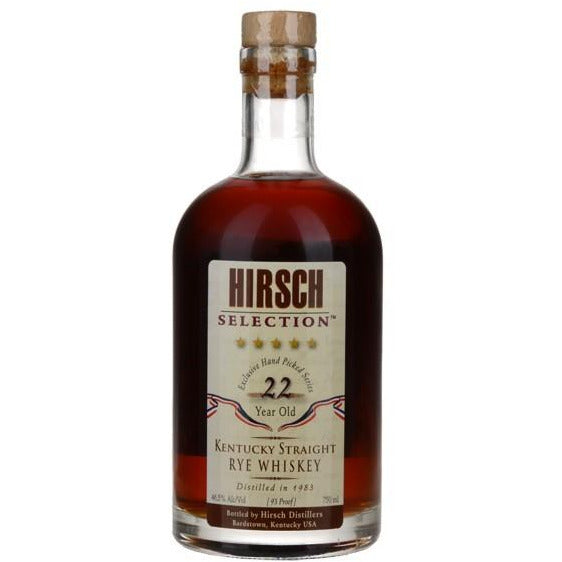
The Hirsch Selection 1983 22 Year Old is a distinct expression from the A.H. Hirsch Reserve program but part of the same Preiss Imports / Hirsch name family. Distilled in 1983 at Bardstown, Kentucky using column stills and aged 22 years, bottled at 46.5% ABV. This is not the Pennsylvania pot still rye of the Reserve program — it is a Kentucky straight rye from a different era and production method, presented as part of Preiss's Hirsch Selection supreme hand-picked series. The 22-year Kentucky rye produces its own deep oak and dried fruit complexity at extended age. Available at $2,999.99 — the most accessible Hirsch expression in the catalog and a natural complement to the Reserve program for collectors building a complete Hirsch vertical.
The Wax Seal Hierarchy and What It Means for Collectors
The A.H. Hirsch Reserve wax seal designations — Gold, Black, Blue, Red — are not arbitrary colors. They identify different Preiss Imports presentation formats released at different points in the program's bottling history, and within each color designation, condition grades matter enormously.
The collector condition hierarchy for wax-sealed Hirsch bottles, from highest to lowest, is: Perfect Wax (entirely intact, no deterioration), Mint Wax (exceptional preserved state with minor wear acceptable), and standard. For bottles now over 30 years old, wax condition is one of the primary determinants of collector premium alongside provenance documentation and fill level.
The Spring 1974 designation on certain Gold Wax bottles provides an additional layer of provenance granularity that the non-dated variants lack. Combined with Perfect Wax condition, the Spring 1974 Gold Wax 750ml is the most precisely documented and highest-condition Hirsch expression in the Wooden Cork collection.
The Julian Van Winkle III Connection
The involvement of Julian Van Winkle III in the A.H. Hirsch Reserve program is one of American whiskey's most significant and least widely understood historical connections. Julian — grandson of the legendary Pappy Van Winkle, the figure whose name now attaches to the most sought-after allocated bourbon in the country — personally oversaw the selection and bottling of the Hirsch Reserve across multiple release variants.
His role was not ceremonial. Julian was one of the most respected tasting and blending palates in American bourbon, and his personal involvement in bringing the 1974 Schaefferstown stock to market reflects the genuine regard he had for the liquid. The gold wax bottlings that Julian supervised before the brand passed to Sazerac are documented pieces of Van Winkle family bourbon history that exist entirely outside the Old Rip Van Winkle and Pappy labels.
For collectors who track American bourbon provenance seriously, the Hirsch / Van Winkle connection provides a through-line between two of the most historically significant names in the category.
The Wooden Cork Hirsch Collection
Wooden Cork's A.H. Hirsch collection spans the full range of the Reserve program and the Hirsch Selection — from the 15 Year Gold Wax Perfect Wax European export bottling through every 16-year wax variant to the 20-year Red Wax expressions and the 1983 22 Year Kentucky rye.
This breadth of selection is unusual. Most secondary market sources carry one or two Hirsch expressions; a catalog covering nine distinct bottlings across the full age spectrum and wax hierarchy represents a depth that collectors building a comprehensive Hirsch vertical are unlikely to find elsewhere.
Every bottle in the collection is finite. There is no reorder mechanism. When the last bottle of each expression sells, that exact liquid is gone from the market permanently. The Spring 1974 Gold Wax Perfect Wax at $16,669 exists in one bottle. The 15 Year Gold Wax Perfect Wax 700ml exists in one bottle. The 20 Year Mint Condition Red Wax exists in one bottle.
Browse the complete A.H. Hirsch collection at Wooden Cork.